The feature that’s not a feature
Today post is a little bit special. There’s no new feature or update on Midway, but I wanted to share some of the work done in the background to make Midway successful.
Midway is not something you are going to use every day. This is what it’s called a « pencil software » i.e. you pick it up, use it, put it down. So even if Midway is really good at solving a problem, it needs to be found when the user is facing it. And to do that, you need to be referenced by the search engines (and the AI chatbots).
One way is to produce content related to the domain of your product to optimize the probability to be ranked higher by the search engines. You build a topical map, i.e. a set of articles organized in pillars and clusters around the theme of your product. For Midway, the pillars can be: family reunion, tool to find direct flights, company retreat, etc. And clusters below the family reunion can « US domestic family destinations » or « intercontinental family reunions ». Under those clusters, you put articles for a specific use case, like finding a romantic getaway for a couple living in Miami and Los Angeles, for example.
To drive the conversion, I built 2 widgets to include an interactive map and table inside the articles so people can see the actual results based on the content. I use Astro as the CMS of my marketing, and I have a specific markdown converter that use this notation
::midway-map{from="LAX,MIA"}
To build this map:
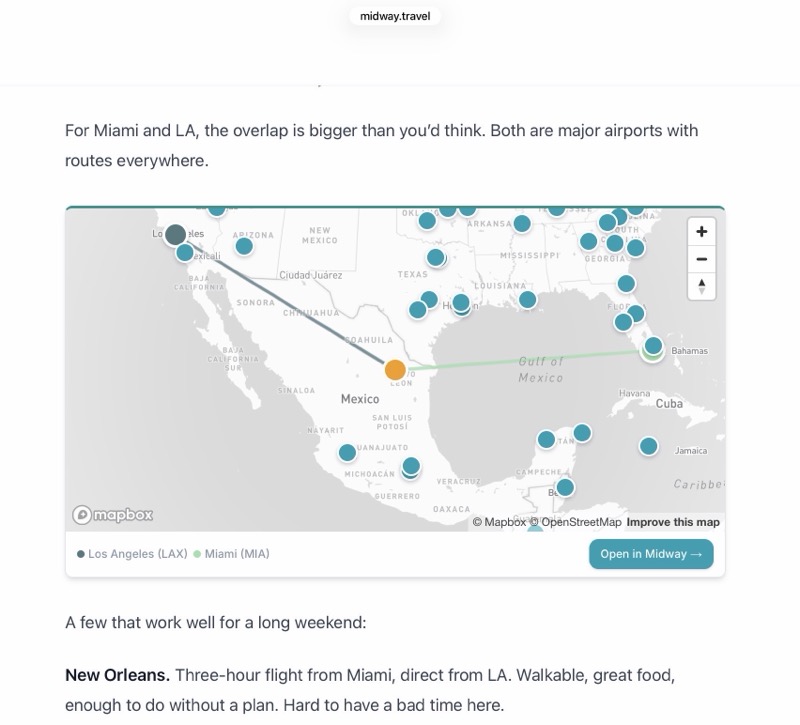
You can take a look at the widgets in this article about finding a getaway destination for a couple living in different cities.
Later on, I can open this widget to external websites to allow people writing travel content to reference Midway and, in the process, build a set of organic backlinks, another signal of authority for search engines.
I hope I didn’t bore you with this behind-the-curtain story. Next week, we will be back to our normal programming!
Subscribe to the newsletter below to follow Midway's development.
Post published in Midway on