Your airport is probably on Midway now
The main selling point of Midway is hiding the complexity of airport data from the users.
Each airport has a list of destinations that varies depending on the time of year and the day of the week. So if you try to find a destination without a specific date in mind, there’s a lot of guesswork involved.
The traditional travel websites are all built around the same logic: you have a specific date and destination and you want to find the cheapest ticket. With Midway, we start earlier in the funnel: you don’t yet have a destination or even a precise date. You just need to know where you’re leaving from, and you’ll get your options. From there, you can narrow down by month, distance, region or country — but without any effort, you can already start exploring the cities you can reach.
When I started working on Midway, I knew it would be a difficult problem to solve because data in the airline industry is very fragmented and not really tailored for this use case. That’s why I started with a subset of airports — the 600 most active ones, 100 per continent.
Now that the core features are in place, I’ve extended the scope of airports supported by Midway. If a departure airport is not available, we fetch the data on demand and compute the possible destinations. Here’s an example with Paris (CDG) and Québec City (YQB).
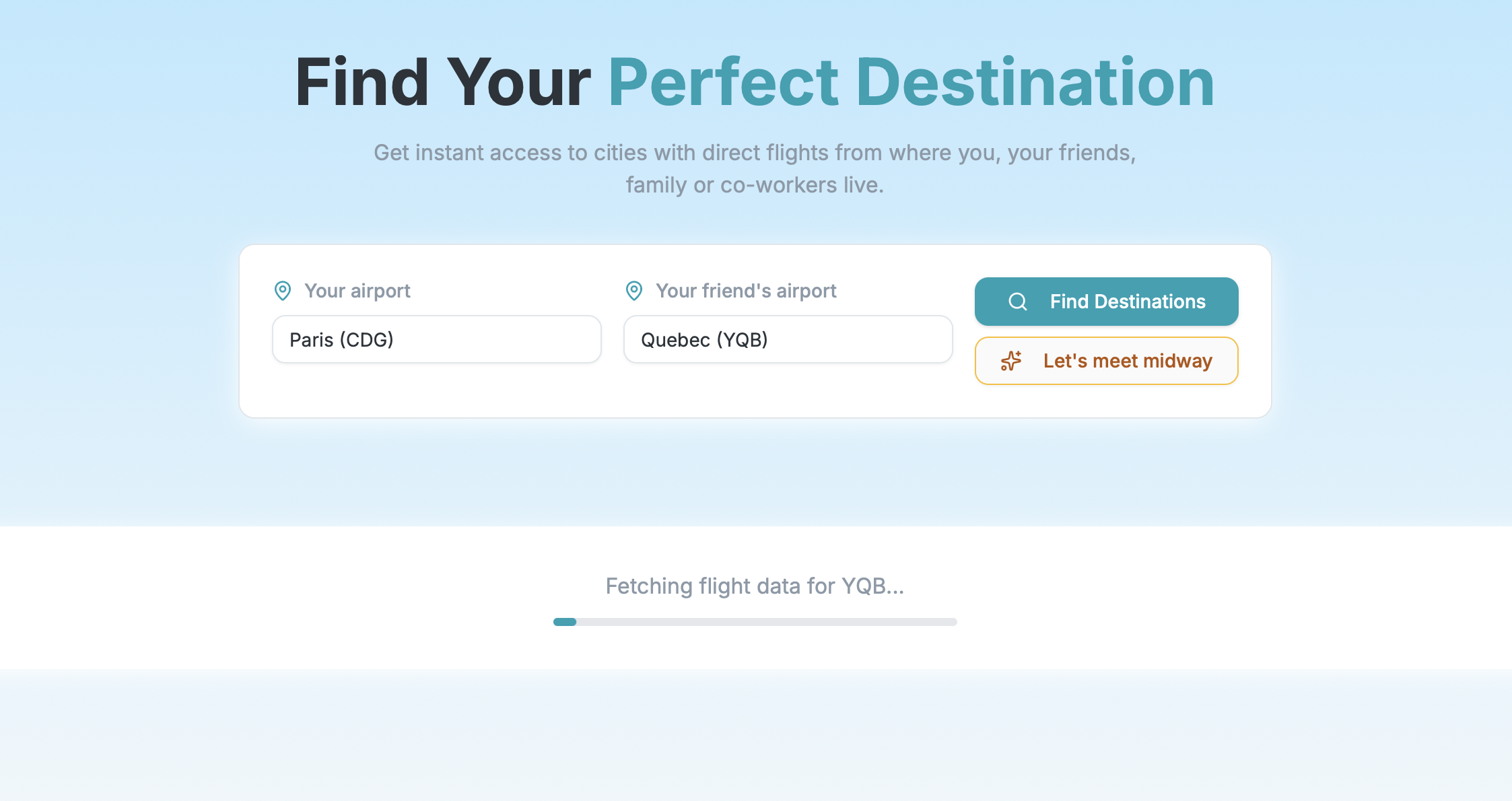
The next feature for the MVP of Midway is adding more departure airports beyond the current two. Supporting multiple departures opens the door to family reunions or company retreats, though it’s tricky to pull off cleanly in terms of user experience — we want to keep things as simple as possible.
Subscribe to the newsletter below to follow Midway's development.
Post published in Midway on